
EBİ EXPORT is a foreign trade company that provides services to hypermarkets, fast moving consumer goods suppliers, ethnic markets and wholesalers. We are exporting to more than 20 different countries.
EBİ EXPORT is a foreign trade company that provides services to hypermarkets, fast moving consumer goods suppliers, ethnic markets and wholesalers. We are exporting to more than 20 different countries.
It is an Ebi Export Brand
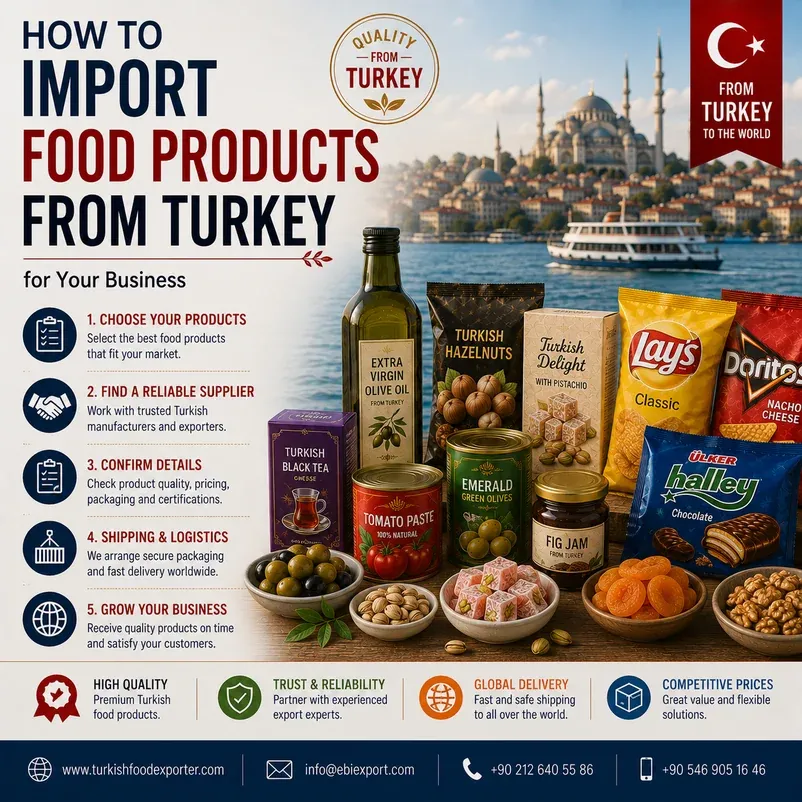
 How to Import Food Products from Turkey for Your Business
Importing food products from Turkey can be a strong business opportunity for supermarkets, wholesalers, ethnic markets, distributors and FMCG companies. Turkey offers a wide product range, including staple foods, snacks, beverages, tea, coffee, confectionery, sauces, personal care items and household cleaning products. For buyers, the key is not only finding Turkish products, but building a reliable import process from product selection to shipment.
A successful import operation starts with clear planning. Before asking for prices, businesses should understand their market needs, target customers, preferred product categories and order structure. Turkish Food Exporter, as an Ebi Export brand, helps international buyers source food and FMCG products from Turkey with a practical export-focused approach.
Turkey is a strong sourcing country because it has developed food production, well-known brands, flexible supply options and a strategic location between Europe, Asia, the Middle East and Africa. This makes food export from Turkey practical for many different markets.
Importers can source both traditional Turkish products and modern FMCG categories. Products such as pasta, tomato paste, sauces, spices, Turkish delight, halva, chips, biscuits, fruit juice, bottled water, tea and coffee can be suitable for retail shelves and wholesale distribution.
Another advantage is product variety. A buyer does not have to focus on only one category. A supermarket or distributor can build a mixed order with pasta products, snacks, beverages, confectionery and household goods. This allows businesses to test different product groups and understand what sells best in their own market.
Before importing food products from Turkey, the first step is to define your target market clearly. A business selling to ethnic grocery stores will not always need the same products as a hypermarket chain or a regional wholesaler. Each sales channel has different expectations.
Ethnic markets may prefer traditional products such as Turkish tea, Turkish coffee, halva, jam, molasses, Turkish delight, sauces and tomato paste. Supermarkets may look for branded snacks, beverages, pasta, cleaning products and personal care items. Wholesalers may focus on carton quantities, price competitiveness and repeat availability.
When the target market is clear, the product selection becomes much easier. Instead of importing random products, your business can build a focused list that matches real customer demand.
Choosing the right categories is one of the most important parts of importing from Turkey. Many buyers start with products that are easy to explain, easy to display and suitable for repeat purchase. Staple foods are often a good starting point because they are used regularly in daily cooking.
Categories such as Turkish tomato paste, pasta, sauces, spices, soup mixes and ready meals can work well for grocery stores and food distributors. These products are practical, familiar and suitable for many markets.
Snack products are also strong candidates. Chips, biscuits, crackers, wafers, chocolate, gum and candy products can help retailers create a fast-moving shelf section. For many importers, Turkish chips and snack products are useful because they appeal to both ethnic customers and general retail shoppers.
Beverages can complete the product mix. Bottled water, soda, fruit juice, lemonade and iced tea products from Turkey can support a stronger FMCG portfolio. Importers can also consider tea, coffee, personal care and cleaning products depending on their market.
Finding a supplier is easy. Finding a reliable export partner is the real work. A professional Turkish food exporter should provide clear product information, updated availability, packaging details, carton quantities, shelf life and realistic shipment planning.
Importers should avoid making decisions based only on a product photo or a short price list. Food import requires details. Product size, barcode, label language, carton structure, pallet details, minimum order quantity and expiry dates can all affect the final decision.
Turkish Food Exporter supports businesses that want to source Turkish food and FMCG products through an organized process. Instead of dealing with scattered suppliers, buyers can evaluate different categories and create a more complete import plan from Turkey.
Before confirming an order, businesses should request complete product details. This includes product name, brand, package size, carton quantity, shelf life, storage conditions and shipment availability. These details help importers calculate landed cost, shelf pricing and warehouse planning.
Packaging is especially important for retail. A product may be suitable for one market but not ideal for another if the package size, language or design does not match customer expectations. Importers should check whether the product can be sold directly or whether additional labeling may be required in the destination country.
For example, a buyer importing fruit juice products from Turkey should review package type, carton structure, flavor options and shelf life. A buyer importing tomato paste should check gram size, tin or jar format and carton count. Small details shape the whole import calculation.
Importers can build orders in different ways. Some businesses may prefer a full container of one product category. Others may need a mixed FMCG shipment with many product groups. The best structure depends on budget, demand, market size and sales strategy.
For a first order, many buyers prefer a balanced selection. This allows the business to test products before scaling. A mixed order may include snacks, beverages, pasta, tomato paste, Turkish delight, tea, coffee and cleaning products. After sales performance becomes clear, the importer can increase the strongest categories.
This step is where experience matters. A good exporter can help buyers avoid weak combinations and focus on products that make sense together. Random variety creates confusion; planned variety creates commercial strength.
Every destination country has its own import rules. Food products may require ingredient checks, label requirements, certificates, customs documentation or specific approvals. Before placing an order, importers should confirm local regulations with customs brokers or relevant authorities in their own country.
This is not a step to ignore. A product that is easy to sell in one country may require different labeling or documentation in another. Importers should check these requirements early so shipment planning does not become a last-minute problem.
A professional Turkish food exporter can help prepare export-related documents, but the importer should also understand the import side in the destination market. Both sides must work together for a clean process.
Logistics planning depends on order volume, product type and destination country. Products may be shipped by sea, road or air depending on the market and urgency. For most wholesale food and FMCG orders, sea or road transport is usually more practical than air freight.
Importers should discuss loading options, estimated transit times, pallet structure and documentation before shipment. If the order includes different product categories, planning becomes even more important. Products must be prepared, packed and loaded in a way that supports safe delivery.
Clear communication during logistics prevents delays and misunderstandings. In international trade, silence is expensive. A good exporter keeps the buyer informed during order preparation, loading and shipment.
For many businesses, the smartest way to import food products from Turkey is to start with a practical test order. This helps the importer understand customer response, product rotation, pricing and shelf performance. Once the strongest products are identified, the business can place larger and more focused orders.
This approach is especially useful for new markets. Instead of guessing which products will sell, the buyer can use real sales data. Snacks may perform strongly in one market, while tomato paste, tea, coffee or Turkish delight may perform better in another.
Turkish Food Exporter can support this process by helping buyers evaluate product groups and build orders according to their business goals.
Importing food products from Turkey becomes easier when the process is organized from the beginning. Define your market, choose the right categories, request clear product details, check regulations, plan logistics and work with an exporter that understands wholesale business.
Turkey has a wide food and FMCG product range for international buyers. With the right sourcing partner, businesses can access reliable Turkish products and build a long-term supply structure for supermarkets, ethnic markets, wholesalers and distributors.
For companies looking to import food products from Turkey, Turkish Food Exporter offers a practical starting point with different categories, export experience and a product range designed for global retail and wholesale needs.